Abstract
Nigeria faces one of Sub-Saharan Africa’s most severe energy poverty crises, with over 85 million people lacking electricity access, a challenge that disproportionately affects more than 2.5 million Internally Displaced Persons (IDPs) in conflict-affected North-East Nigeria. Despite national electrification efforts, humanitarian settlements remain largely excluded from reliable power infrastructure. This study evaluates the technical feasibility, spatial energy gaps, and policy barriers associated with deploying decentralized solar and hybrid solar–wind systems in IDP settlements across six North-Eastern states. A mixed-method geospatial framework was applied, integrating Visible Infrared Imaging Radiometer Suite (VIIRS) nighttime light data, Geo-Referenced Infrastructure and Demographic Data for Development (GRID3) infrastructure datasets, and Distributed Renewable Energy (DRE) demand data using Python and Quantum Geographic Information System (QGIS). Nighttime light intensity was classified into no-access (≤100 nW/cm²/sr), limited-access (101–1000 nW/cm²/sr), and full-access (>1000 nW/cm²/sr) categories. Results identified 670 IDP camps across 112 Local Government Areas (LGAs), with high concentrations in Bauchi (264 camps), Borno (194), and Gombe (140), predominantly located within limited-access zones. Solar resource assessment shows strong regional potential (4.2–4.6 kWh/m²/day Global Horizontal Irradiation (GHI)), while average wind speeds of 2–4 m/s support small-scale hybrid applications. A representative camp load analysis (3.72 kWh/day) demonstrates that a 0.99 kWp solar array combined with a 3.2 kWh battery and a 300 W vertical-axis wind turbine can reliably meet basic household energy needs, reducing approximately 25.88 kgCO2e per household annually. Key barriers include high upfront costs, limited financing mechanisms, weak humanitarian energy policy integration, and security-related operational risks. The study provides empirical evidence for integrating decentralized renewable energy into national electrification strategies through risk-informed planning and tailored financing models to enhance resilience, sustainability, and dignity in displacement settings.
Keywords
Decentralized Renewable Energy, Internally Displaced Persons (IDPs), Geographical Information Systems, Humanitarian Energy, Solar Electrification, Nigeria, Energy Access, Nighttime Light
1. Introduction
Access to reliable, affordable, and sustainable energy is widely recognized as a foundational driver of socio-economic development, climate resilience, and human security
| [19] | REN21. (2023). Renewables 2023 global status report. REN21 Secretariat. |
[19]
. Sustainable energy systems are central to achieving Sustainable Development Goal 7 (SDG 7), yet energy poverty remains pervasive across Sub-Saharan Africa
| [10] | International Energy Agency (IEA). (2023). Africa Energy Outlook 2023. IEA Publications. |
[10]
. Decentralized renewable energy (DRE) systems particularly solar photovoltaic (PV), mini-grids, and hybrid renewable configurations have been widely identified as scalable pathways for electrifying underserved regions where grid extension is technically or economically unviable
| [4] | Bhattacharyya, S. C. (2013). Energy economics: Concepts, issues, markets and governance. Springer. |
| [9] | International Energy Agency (IEA). (2022). World energy outlook 2022. IEA Publications. |
[4, 9]
. Empirical evidence further demonstrates that decentralized energy access improves health outcomes, enhances educational opportunities, and stimulates microenterprise development in low-income settings
| [18] | Pueyo, A., & Maestre, M. (2019). Energy poverty and development impacts. World Development Research, 117, 1–12. |
[18]
.
Despite growing investment in decentralized renewable energy, humanitarian and displacement settings remain largely excluded from mainstream electrification planning frameworks
| [20] | Scott, A., Stilgoe, J., & Guston, D. (2019). Governance challenges for humanitarian energy. Energy Research & Social Science, 56, 101234. |
[20]
. Energy governance scholarship has highlighted that fragile and conflict-affected contexts present unique institutional and operational challenges that conventional electrification models often fail to address
| [3] | Bazilian, M., Nakhooda, S., & Van de Graaf, T. (2012). Energy governance and poverty. Energy Research & Social Science, 2, 1–8. |
| [17] | Peters, J., & Sievert, M. (2019). Energizing development in conflict zones. Energy Policy, 128, 663–676. |
[3, 17]
. In such settings, decentralized systems must account for insecurity, climate vulnerability, financing barriers, and governance fragmentation
.
Nigeria presents one of the most severe electricity access deficits globally, with approximately 85 million people lacking access to reliable grid electricity
| [22] | World Bank. (2021). Electricity access data for Nigeria. World Bank Data. |
[22]
. The crisis is most acute in North-East Nigeria, where prolonged insurgency, infrastructure destruction, and climate-induced displacement have forced over 2.5 million people into Internally Displaced Persons (IDP) settlements. In these communities, electricity access is minimal or non-existent, resulting in heavy reliance on diesel generators and traditional biomass fuels, which are financially unsustainable and environmentally damaging
| [5] | Blechinger, P., Achat, D., & Bazilian, M. (2020). The role of backup power in electricity access in low-income countries. Energy Policy, 138, 111253. |
[5]
.
Recent sustainability research emphasizes that renewable energy deployment in fragile regions must integrate risk-informed planning, climate adaptation strategies, and flexible modular system design
. North-East Nigeria faces compounding environmental pressures including desertification, erratic rainfall, flooding, and extreme heat that further complicate infrastructure deployment and system durability. Hybrid renewable systems combining solar and wind technologies have been shown to enhance resilience and reliability in climate-sensitive environments
| [1] | Adewuyi, A. O., Omoyele, O. A., & Adebayo, T. S. (2022). Assessing decentralized renewable energy deployment in Nigeria: A comprehensive review. Academic Energy Journal, 8(041). https://doi.org/10.20935/AcadEnergy8041 |
| [2] | Ahmad, Aliyu & Abaje, I. B. & Ibrahim, Ishiaku & Bello, Yusuf & Usman, Badaru. (2024). Relationship of Hydroclimate Variables and Power Generation in Jebba Dam, North Central Nigeria. International Journal of Environment and Climate Change. 14. 648-659. https://doi.org/10.9734/ijecc/2024/v14i13880 |
[1, 2]
.
While existing literature has examined decentralized renewable energy potential in Nigeria, most studies focus on rural electrification, techno-economic optimization, or policy design at national scale
| [1] | Adewuyi, A. O., Omoyele, O. A., & Adebayo, T. S. (2022). Assessing decentralized renewable energy deployment in Nigeria: A comprehensive review. Academic Energy Journal, 8(041). https://doi.org/10.20935/AcadEnergy8041 |
[1].
Very limited empirical research explicitly examines the intersection of displacement dynamics, spatial energy poverty, renewable resource potential, and humanitarian energy governance. Moreover, few studies integrate geospatial satellite-based electrification proxies such as Visible Infrared Imaging Radiometer Suite (VIIRS) nighttime light data with IDP distribution datasets to identify electrification gaps in displacement settings
| [6] | Chen, X., & Nordhaus, W. D. (2011). Using luminosity data as a proxy for economic activity. Proceedings of the National Academy of Sciences, 108(21), 8589–8594. |
| [7] | Elvidge, C., Hsu, F.-C., Baugh, K., & Ghosh, T. (2017). VIIRS nighttime light data for electricity access mapping. Remote Sensing, 9(1), 1–19. |
[6, 7].
Combining geospatial analytics with renewable resource and policy assessment remains underexplored in displacement settings
| [15] | Long, A., & Wood, A. (2022). Renewable systems in fragile settings. Journal of Energy for Development, 48(2), 122–138. |
| [16] | Meyer, J., Scott, L., & Pueyo, A. (2022). Combining satellite data with household surveys for electrification analysis. Energy for Sustainable Development, 66, 1–11. |
[15, 16]
.
This study addresses these gaps by providing a multi-dimensional assessment of decentralized renewable energy deployment in IDP settlements across North-East Nigeria. Specifically, it integrates:
1) Geospatial analysis of energy access using VIIRS nighttime light intensity data;
2) Infrastructure and displacement mapping using Geo-Referenced Infrastructure and Demographic Data for Development (GRID3) datasets;
3) Energy demand classification from Distributed Renewable Energy (DRE) records;
4) Resource-based feasibility analysis of solar and wind potential;
5) Technical sizing of representative solar-only and hybrid solar–wind systems;
6) Policy and financing gap assessment within humanitarian and national electrification frameworks.
By combining spatial analytics with system design modeling, this research moves beyond descriptive energy poverty narratives toward actionable techno-policy insights tailored to fragile and displacement contexts.
The overall aim of this study is to evaluate the feasibility, barriers, and policy implications of deploying decentralized hybrid solar–wind systems for IDPs in North-East Nigeria. The specific objectives are:
1) To assess the technical and environmental feasibility of decentralized renewable energy systems in IDP settlements;
2) To examine spatial correlations between IDP distribution and electricity access gaps;
3) To evaluate the adequacy of existing renewable energy policies in addressing displacement contexts;
4) To propose evidence-based recommendations for integrating humanitarian energy into national electrification strategies.
This study is guided by the following hypotheses:
1) Hybrid solar–wind systems are technically viable for IDP settlements despite climate and security constraints.
2) Current renewable energy policies in Nigeria are insufficiently adapted to displacement and humanitarian environments.
3) Security risks, financing barriers, and institutional limitations constitute primary constraints to sustainable deployment.
4) Satellite-derived nighttime light data provide a reliable macro-scale proxy for identifying energy poverty in displacement settings.
By situating decentralized renewable energy within the broader discourse on sustainability transitions, fragile-state governance, and humanitarian resilience, this research contributes new empirical evidence to the emerging field of humanitarian energy planning. It provides a replicable analytical framework that can inform policymakers, humanitarian agencies, and renewable energy developers working in conflict-affected and climate-vulnerable regions.
2. Methodology
2.1. Research Design and Analytical Framework
This study employed a systematic approach that combined geospatial datasets, satellite imagery, and national energy records to evaluate energy access patterns in North-East, Nigeria. The methodology followed a structured workflow beginning with data collection from multiple sources, as listed in
Figure 1, then cleaning and preprocessing, and culminating in spatial and computational analyses using Python and Quantum Geographic Information System (QGIS). This process enabled the mapping of energy access, classification of energy demand, and identification of underserved communities and critical facilities. This work also proposes decentralized renewable energy solutions for the identified IDP camps within the underserved communities. Using an assumed load profile and a preliminary energy audit, the corresponding renewable energy systems were designed.
Figure 1. Methodology Flowchart for Energy Access Research in North-East Nigeria.
2.2. Data Sources and Geospatial Analysis
A. Data Collection
Data for this study were obtained from three primary sources:
1) GRID3 Nigeria:
a) Provided point datasets for schools, internally displaced persons (IDP) camps, and health facilities in CSV format. These datasets were used to map the spatial distribution of these facilities.
b) Administrative boundary shapefiles for Nigerian states and LGAs were also sourced from GRID3 to delineate the study area.
2) Google Earth Engine (GEE):
a) Supplied Visible Infrared Imaging Radiometer Suite (VIIRS) satellite imagery was used to extract nighttime light (NTL) intensity data in GeoTIFF format as a proxy for energy access. The unit of nighttime light (NTL) radiance for VIIRS data is nanowatts per square centimeter per steradian (nW/cm²/sr). This means the pixel value represents the amount of radiant energy (in nanowatts) emitted per unit area (cm²) and per unit solid angle (steradian).
b) While VIIRS night-time light imagery offers a valuable proxy for assessing spatial patterns of electricity access, it is not without limitations. The data primarily capture visible outdoor illumination and may therefore underestimate access in rural or dispersed communities where electricity is used predominantly indoors or through low-intensity decentralized systems such as solar lanterns and mini-grids. Conversely, urban and industrial centers often produce strong light signals that can saturate the sensor, potentially overstating actual access levels. Moreover, night-time lights do not account for the affordability, reliability, or quality of supply, meaning that households recorded as having “access” may still experience limited or irregular electricity. Recognizing these constraints is essential for contextualizing the results of this study and for interpreting night-time light intensity as an indicative rather than absolute measure of energy access
| [8] | Falchetta, G., Pachauri, S., Parkinson, S., & Byers, E. (2019). A high-resolution gridded dataset to assess electrification in sub-Saharan Africa. Scientific Data, 6(1), 110.
https://doi.org/10.1038/s41597-019-0122-6 |
[8]
.
3) Nigeria – Distributed Renewable Energy (DRE):
a) The energy demand and security risk datasets were provided in GeoJSON format, representing electricity supply from the national grid, which is predominantly generated from hydropower sources.
B. Data Cleaning and Preprocessing
Given the focus on six states in the North East region of Nigeria, data cleaning was performed as follows:
1) Python Processing:
The DRE dataset, which was too large to open directly in QGIS, was filtered in Python to retain only the six target states. Unnecessary attributes were removed to enhance computational efficiency.
2) QGIS Operations:
State and Local Government Area (LGA) administrative boundaries were clipped to the study area. The VIIRS imagery was processed using QGIS's Zonal Statistics tool to calculate the total nighttime light intensity per LGA.
C. Analytical Procedures
To achieve the research objectives, three core analyses were conducted:
1. Energy Access Mapping
Nighttime light intensity values from VIIRS imagery were aggregated at the LGA level using Zonal Statistics. The resulting attribute column (Sum) represents the total light intensity per LGA, with values ranging from 7.265 to 3,079.313 nW/cm²/sr.
Energy access levels were classified using QGIS’s Field Calculator, and to enhance visual discrimination of illumination levels on the thematic map, the intensity thresholds were re‑scaled as follows:
1) No Access: Sum ≤ 100 nW/cm²/sr
2) Limited Access: 101 ≤ Sum ≤ 1,000 nW/cm²/sr
3) Full Access: Sum > 1,000 nW/cm²/sr
This discretization preserves the ordinal relationship of the original categories while expanding the dynamic range, thereby producing more distinct cartographic shapes for analytical interpretation. Distinct colors were assigned to each category using the Symbology tool for visualization.
2. Distribution of IDP Camps by Energy Access
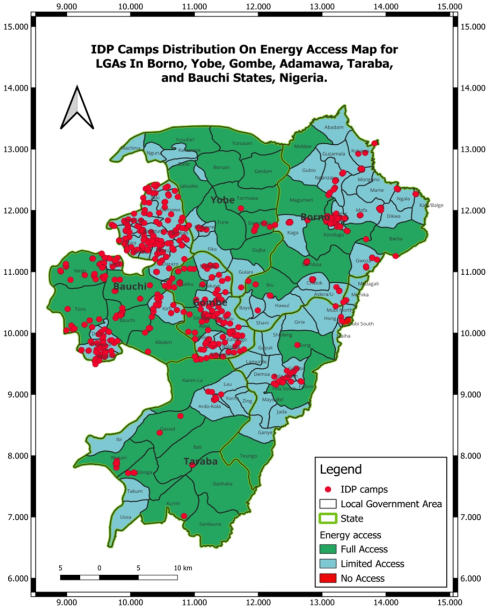
The IDP camp dataset was spatially overlaid on the classified energy access map. This facilitated an assessment of the relationship between IDP settlement locations and their corresponding energy access levels (see
Figure 5).
3. Energy Demand Classification
The DRE energy demand dataset was integrated with the LGA boundaries to assess electricity needs across the region. Demand values were classified into three categories:
1) Low Demand
2) Medium Demand
3) High Demand
The classification was based on the quantile distribution of demand values. This analysis helped prioritize LGAs with the highest energy requirements, especially where demand overlapped with limited access areas.
2.3. Renewable Resource Assessment and System Design
1. Load Analysis
Given the goal of proposing renewable energy systems for these IDP camps, we conducted a load analysis. The load assessment for the IDP camp was conducted by evaluating the power ratings of the appliances expected to be used within the settlement and estimating their corresponding hours of operation. This approach provided an informed projection of the total daily energy demand, forming the basis for designing an appropriate solar-wind powered electricity system and energy storage components required to ensure a reliable and sustainable power supply for the settlement. In locations with abundant sunlight and wind potential, hybrid renewable energy solutions were analyzed and proposed.
The daily energy requirement for the system was computed by multiplying the total connected load by the estimated duration of operation, as expressed by
(1)
2. System Design
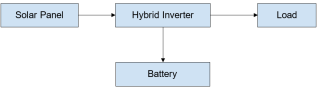
The proposed power system comprises solar photovoltaic panels, a wind turbine, a hybrid inverter, an energy storage system, and the associated load. Two configurations were considered: a solar-only system (see
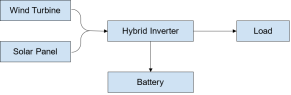
Figure 2) and a hybrid solar–wind system. In the hybrid configuration, the electrical outputs from the solar PV array and the wind turbine are combined and supplied as input to the hybrid inverter, as illustrated in
Figure 3. The inverter manages power conversion, system control, and the coordinated charging of the battery bank while supplying electricity to the connected loads.
A. Solar-only System
The procedure for designing the solar-only system is as follows;
1) Load estimation
2) Sizing and selection of solar panels
3) Sizing and selection of the battery
4) Sizing and selection of a hybrid inverter
Figure 2. Solar-only System Block Diagram.
B. Hybrid Solar-Wind System
Similarly, the hybrid solar-wind system follows these procedures;
1) Load estimation
2) Selection of a wind turbine
3) Sizing and selection of solar panels
4) Sizing and selection of the battery
5) Sizing and selection of a hybrid inverter
3. Load estimation:
The combined appliance load was estimated at 250 W based on an assumed operating schedule. The total energy demand for households during the day and night was approximately 3,720 Wh/day (3.72 kWh). For more information on the load assessment, see the supporting information.
Figure 3. Solar-Wind System Block Diagram.
4. Sizing and selection of solar panels:
The solar photovoltaic (PV) capacity was determined based on the total daily energy demand given by (Eq. (
1)) and the available peak sun hours (PSH) for the project location. The total load requirement of 3720 Wh/day was first adjusted to account for system losses using the relation:
(2)
where the loss factor incorporates wiring losses, temperature losses, and panel tolerance (85–90%).
Using an average North East, Nigeria PSH of 4.5 hours, the estimated PV array size was computed as:
Based on available commercial panel ratings (300 Wp, 330 Wp, and 500 Wp), an optimal configuration of 3 × 330 Wp panels was selected, providing 0.99 kWp, which exceeds the minimum requirement and ensures system reliability under fluctuating irradiance conditions. This sizing approach ensures adequate energy generation for both daytime consumption and battery charging.
5. Sizing and selection of the battery:
Battery capacity was sized to ensure adequate energy availability during low-solar periods, incorporating the desired days of autonomy and allowable depth of discharge (DoD). The required storage capacity was obtained using:
(3)
Considering an autonomy of 1 day, battery efficiency of 80–95%, and a depth of discharge (DOD) of 80% for a lithium-ion battery, the required storage was calculated as:
Battery Storage ≈ 3.16 kWh.
Using a 12 V system, this corresponds to approximately 263 Ah. Commercially available options (100 Ah, 250 Ah) were evaluated, and a 3.2 kWh battery configuration (12.8V, 250 Ah unit) was selected, requiring 1 unit to achieve the desired storage capacity. This provides sufficient reserve for nighttime demand and ensures longer battery lifespan under cyclic operation.
6. Sizing and selection of a hybrid inverter:
Inverter capacity was determined based on the total connected load given by and a safety factor to accommodate startup surges and efficiency losses. With a peak load of 250 W and continuous daily consumption of 3720 Wh, the inverter power rating was calculated using:
(4)
Where a tolerance load of 25% was considered, and the inverter efficiency ranges from 90–95%.
The estimated capacity requirement of 0.40 kW (400 W) was derived from this calculation. To ensure operational stability and allow for future load expansion, a kilo-Watt hybrid inverter was selected. The hybrid configuration supports integration with solar PV, battery storage, and auxiliary AC sources, improving system versatility and resilience.
7. Selection of wind turbine
The wind turbine selection approach used in this study is based on the methodology of
| [14] | Issa, N., Adamu, A., Lamba, H. D., Riagbayire, F. V., Abdulganiyu, M., & Auwal, S. (2025). Design and installation of a solar and wind hybrid system in Kano State, Nigeria. American Journal of Energy and Natural Resources, 4(1), 20–28. https://doi.org/10.54536/ajenr.v4i1.4157 (Accessed on 29 November, 2025). |
[14]
in their work,
“Design and Installation of a Solar and Wind Hybrid System in Kano State, Nigeria.” Their framework, which applies a structured wind resource assessment supported by statistical analysis, formed the basis for evaluating the local wind profile and identifying the most suitable turbine for the hybrid system. In their study, a ten-year wind speed dataset from the Nigeria Meteorological Agency (NiMet) for Kano State was converted from knots to meters per second and analyzed to determine weekly, monthly, and annual averages. Wind speed variability was then modeled using the Weibull probability distribution due to its effectiveness in representing wind dispersion. Using the standard deviation method, the Weibull parameters, the shape (k) and scale (c) were computed as k = 2.92 and c = 5.83 m/s, guiding the turbine performance evaluation.
The probability of turbine operation was subsequently estimated using the Weibull cumulative function, incorporating the turbine’s cut-in, rated, and cut-off speeds. This analysis produced an operational probability of 92%, demonstrating strong site compatibility. The capacity factor, representing expected energy output relative to the turbine’s rated capacity, was calculated as 34.4%. Based on these findings, a vertical-axis wind turbine (VAWT) was selected.
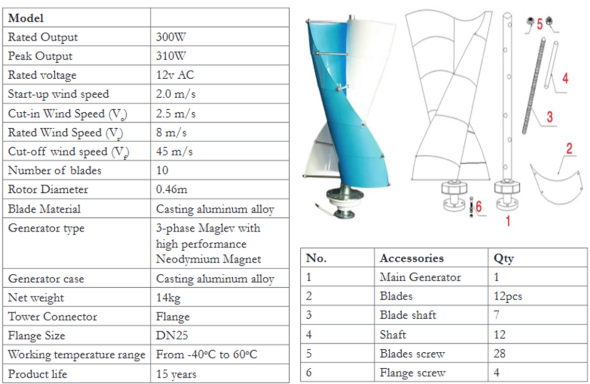
The turbine features a cut-in speed (Vr) of 2.5 m/s and a rated speed (Vc) of 8 m/s, making it suitable for the northern wind characteristics and stable under variable wind directions. The final specification includes a rated power of 300 W, a peak output of 310 W, a rated voltage of 12 V AC, a start-up wind speed of 2.0 m/s, a cut-off speed (Vf) of 45 m/s, and 10 blades (see
Figure 4).
Figure 4. Savonius Vertical Axis Wind Turbine, Specification and Accessories.
3. Results
The results reveal significant disparities in energy access across North-East Nigeria, with IDP camps predominantly located in areas of limited or unreliable electricity, intensifying existing vulnerabilities. Analysis of energy demand and resource availability further shows that while solar potential is strong and wind resources moderate, hybrid renewable systems offer the most viable solution for addressing these critical access gaps.
3.1. Energy Access Distribution
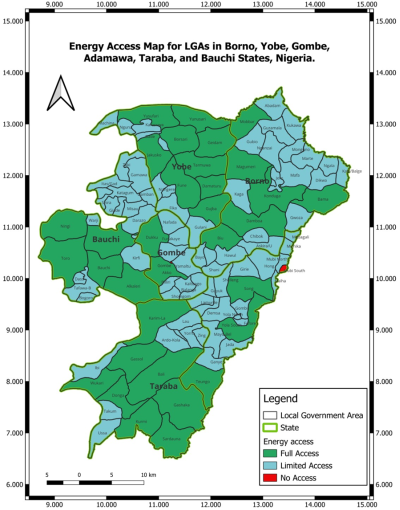
Analysis of energy access patterns in the North East region of Nigeria (see
Figure 5) reveals distinct variations across states and LGAs. Nighttime light intensity values aggregated at the LGA level ranged from 7.265 to 3,079.313 nW/cm²/sr. Based on the classification thresholds:
1) Full Access Areas (Green) (>1000 nW/cm²/sr):
Predominantly observed in parts of Borno, Yobe, Bauchi, and Taraba states. These LGAs benefit from stronger grid connections or functional decentralized energy systems.
2) Limited Access Areas (Blue) (101–1000 nW/cm²/sr):
Widespread across all six states, with particularly high concentrations in Adamawa, Taraba, Bauchi, and Borno. These areas typically rely on unstable or partial electricity supply, often dependent on small generators, mini-grids, or intermittent grid connections.
3)
Minimal occurrence in Mubi South, Adamawa, suggesting that the outright presence of electricity infrastructure is rare. However, energy quality and reliability remain critical challenges even in connected areas.
It is important to note that night-time light data, while useful for highlighting spatial disparities in energy access, may overstate electrification in urban areas and understate access in rural or decentralized systems, as they do not capture reliability, affordability, or quality of supply.
Figure 5. Energy Access Map Across North East, Nigeria.
3.2. IDP Camps Distribution and Energy Access Correlation
The overlay of Internally Displaced Persons (IDP) camps distribution on the energy access map (see
Figure 6) reveals a strong spatial correlation between displacement patterns and inadequate energy infrastructure, underscoring the need for renewable energy solutions in regions with limited access to electricity.
1) High IDP Clusters:
Concentrated in Bauchi, southern Yobe, and central Adamawa. These settlements coincide with limited energy access zones, compounding vulnerabilities by restricting access to essential services such as lighting, healthcare, and water pumping.
2) Sparse IDP Presence:
Found in northern Taraba and parts of Borno, where full access to energy exists.
While nighttime light data provide useful insights into spatial disparities in energy access, they may overstate access in urban areas and understate it in rural or decentralized systems. This limitation is particularly relevant to our findings on IDP camps, many of which rely on low-intensity or off-grid solutions such as small generators, solar lanterns, or mini-grids. These forms of access often fall below the detection threshold of VIIRS imagery, meaning that the energy deprivation experienced by displaced populations could be more severe than indicated in the spatial analysis.
Figure 6. Internally Displaced Persons (IDP) Distribution on Energy Access Map in North East, Nigeria.
3.3. Infrastructure Distribution in Limited Access LGAs
Table 1 and
Table 2 captured the dominant sources of energy for Internally Displaced Persons (IDP) across the North-East, Nigeria. Average limited-access nighttime light intensity (nW/cm²/sr) per state: Adamawa - 274.2 nW/cm²/sr, Bauchi - 475.3 nW/cm²/sr, Borno - 169.9 nW/cm²/sr, Gombe - 328.1 nW/cm²/sr, Taraba - 361.4 nW/cm²/sr, and Yobe - 224.1 nW/cm²/sr. Within limited-access LGAs, the following infrastructure counts were recorded: schools - 11,677 and hospitals - 5,801, along with the IDP Camps.
Table 1. Energy Access Overview across North-East, Nigeria.
State | Dominant Access Type | IDP Presence | Remarks |
Adamawa | Limited | Low | Few IDPs, but overall, limited access |
Bauchi | Full & Limited | High | High IDP concentration in limited access zones. |
Borno | Full & Limited | Moderate | Mixed access; IDPs in limited areas need focus. |
Gombe | Full & Limited | High | IDPs face severe energy gaps. |
Taraba | Limited | Low-Moderate | Mixed IDPs with large areas of full access |
Yobe | Limited | Low–Moderate | Some IDPs are in limited areas. |
Table 2. Limited Energy Access Overview across North-East, Nigeria.
Northeast State | Count of LGA | Sum of IDP_Camps | Avg. Limited_Energy (nW/cm²/sr) | Sum of Hospitals | Sum of Schools |
Adamawa | 21 | 27 | 274.2 | 1203 | 2428 |
Bauchi | 20 | 264 | 475.3 | 1191 | 2374 |
Borno | 27 | 194 | 169.9 | 657 | 1332 |
Gombe | 11 | 140 | 328.1 | 850 | 2173 |
Taraba | 16 | 25 | 361.4 | 1327 | 2555 |
Yobe | 17 | 20 | 224.1 | 573 | 815 |
Grand Total | 112 | 670 | 1833 | 5801 | 11677 |
3.4. Energy Demand Classification by LGA
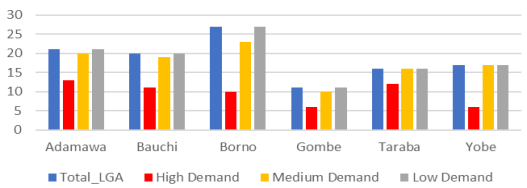
Energy demand classification (see
Figure 7 and
Table 3) was classified using quantile distribution into low, medium, and high demand categories. High-demand LGAs recorded per state, are Adamawa: 13, Bauchi: 11, Borno: 10, Gombe: 6, Taraba: 12, Yobe: 6. Medium-and low-demand LGAs were distributed across all states.
Table 3. Energy Demand Classification within LGA Counts.
Northeast States | Total_LGA | High Demand | Medium Demand | Low Demand |
Adamawa | 21 | 13 | 20 | 21 |
Bauchi | 20 | 11 | 19 | 20 |
Borno | 27 | 10 | 23 | 27 |
Gombe | 11 | 6 | 10 | 11 |
Taraba | 16 | 12 | 16 | 16 |
Yobe | 17 | 6 | 17 | 17 |
Figure 7. Energy Demand Classification within LGA Counts.
3.5. Solar Resource Potential
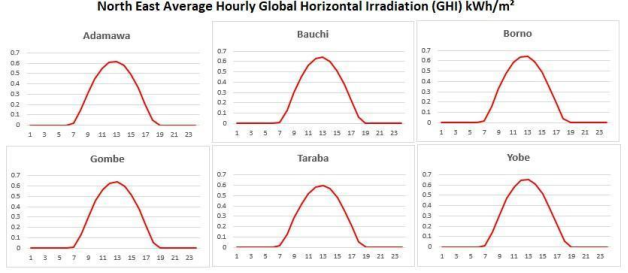
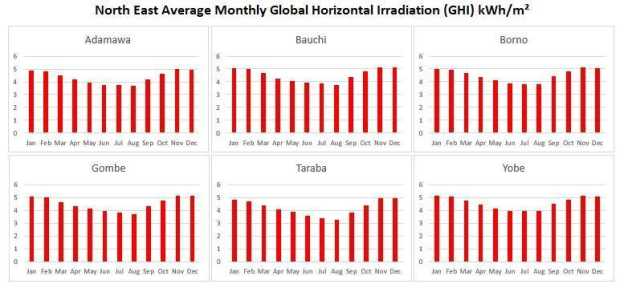
The solar irradiation data from Global Solar Atlas (GSA v2.12) for the North East, Nigeria, reveals average daily Global Horizontal Irradiation (GHI) ranging between 4.2 and 4.6 kWh/m²/day, with hourly peaks between 0.6 and 0.7 kWh/m² occurring from 11:00 a.m. to 2:00 p.m. This level of solar exposure exceeds the typical threshold for effective photovoltaic (PV) generation (4.0 kWh/m²/day) (
Table 4 and
Figure 8)
| [12] | International Renewable Energy Agency. (2022). Renewable Energy Statistics 2022. Abu Dhabi: IRENA. |
[12]
.
Figure 8. Average Hourly GHI line-graph for North East Nigeria.
Table 4. Average Monthly GHI (kWh/m²) for North East, Nigeria.
Northeast States | Jan | Feb | Mar | Apr | May | Jun | Jul | Aug | Sep | Oct | Nov | Dec | Avg/day |
Adamawa | 4.896 | 4.802 | 4.514 | 4.187 | 3.954 | 3.778 | 3.738 | 3.683 | 4.162 | 4.642 | 5.004 | 4.96 | 4.36 |
Bauchi | 5.089 | 4.987 | 4.667 | 4.255 | 4.049 | 3.927 | 3.853 | 3.776 | 4.366 | 4.793 | 5.147 | 5.123 | 4.50 |
Borno | 5.017 | 4.96 | 4.699 | 4.373 | 4.138 | 3.852 | 3.84 | 3.811 | 4.413 | 4.823 | 5.102 | 5.051 | 4.51 |
Gombe | 5.09 | 5.00 | 4.671 | 4.331 | 4.135 | 3.931 | 3.84 | 3.735 | 4.306 | 4.804 | 5.146 | 5.126 | 4.51 |
Taraba | 4.863 | 4.723 | 4.392 | 4.061 | 3.896 | 3.612 | 3.393 | 3.297 | 3.842 | 4.413 | 4.981 | 4.957 | 4.20 |
Yobe | 5.136 | 5.062 | 4.804 | 4.45 | 4.179 | 3.957 | 3.977 | 3.979 | 4.525 | 4.817 | 5.123 | 5.111 | 4.59 |
Figure 9 shows that the high solar resource availability throughout the year, particularly in Borno, Yobe, and Bauchi, supports the feasibility of standalone or hybrid PV systems for decentralized power generation in IDP camps.
Figure 9. Average Monthly GHI bar chart for North East Nigeria.
3.6. Wind Resource Potential
According to the extracted wind data (2004–2023), the region exhibits average wind speeds between 2–4 m/s, with a regional mean of 3.5 m/s, and an average shape parameter (k) of 5.86 and scale parameter (c) of 2.88. The highest wind stability and strength occur in Damaturu (Yobe), Gombe, and Jalingo (Taraba), with shape parameters exceeding 4.5, indicating steady wind conditions
| [13] | Issa, N., Adamu, A. A., Ibrahim, M. M., Iboh, S., Riagbayire, F. V. (2025). Feasibility Study for Wind Data Analysis Across Nigeria's 36 States and the Federal Capital Territory, Abuja. American Journal of Science, Engineering and Technology, 10(3), 141-157. https://doi.org/10.11648/j.ajset.20251003.16 (Accessed on 10 October, 2025). |
[13]
.
Although the mean wind speeds fall below large-scale turbine thresholds, they are sufficient to support small wind systems (1–10 kW) or hybrid configurations that complement solar energy generation, particularly during evening and night hours.
The complementary patterns of solar and wind resources in North East Nigeria create a strong case for hybrid renewable energy systems (see
Figures 6 & 8). Solar PV generation dominates during daytime, while wind power, though moderate, can supplement the system during low-solar or nighttime periods.
3.7. Representative System Design Output
For a daily energy demand of 3.72 kWh/day, the calculated system configuration includes:
1) Solar PV array: 0.99 kWp (3 × 330 Wp panels)
2) Battery storage: 3.2 kWh (12.8V, 250Ah)
3) Wind turbine: 300 W vertical-axis turbine
4) Inverter capacity: 1 kW hybrid inverter
Estimated annual emission reduction: 25.88 kgCO₂e per household.
Key Observation:
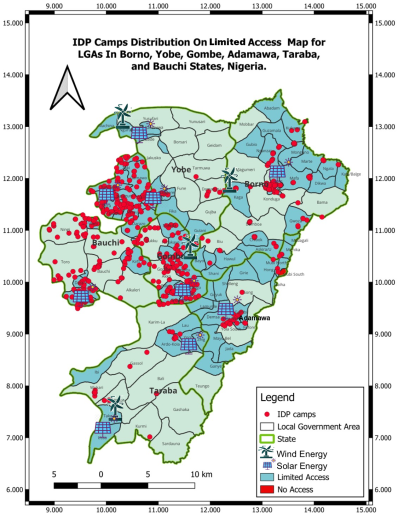
Figure 10 illustrates that the overlap of high IDP density and limited energy access underscores the urgent need for targeted energy interventions in humanitarian contexts.
Figure 10. Renewable Energy Deployment for IDP Camps in Limited Access.
4. Discussion
This study provides empirical evidence that displacement and energy poverty are spatially correlated across North-East Nigeria. The concentration of 670 IDP camps within predominantly limited-access LGAs indicates structural exclusion of humanitarian settlements from reliable electricity infrastructure.
The findings support the hypothesis that hybrid solar–wind systems are technically viable in displacement contexts. Solar irradiation levels exceeding 4.0 kWh/m²/day across all states surpass the minimum threshold for effective photovoltaic deployment. Although wind speeds are moderate (2–4 m/s), they remain sufficient for small-scale vertical-axis turbines, particularly as complementary nighttime generation sources. The hybrid configuration therefore enhances supply reliability compared to solar-only systems.
The spatial mismatch between high energy demand LGAs and limited electricity access highlights systemic planning gaps. States such as Bauchi and Gombe exhibit both high IDP concentrations and significant demand pressure, reinforcing the need for demand-responsive decentralized solutions.
From a governance perspective, the results confirm that current electrification patterns do not adequately incorporate displacement dynamics. The clustering of camps in limited-access zones suggests that humanitarian energy remains peripheral within national electrification frameworks. This aligns with existing scholarship on fragile-state energy governance, which emphasizes institutional fragmentation and financing constraints in conflict-affected regions.
The system design modeling further demonstrates practical feasibility at household scale. A 0.99 kWp solar array with 3.2 kWh storage meets basic load requirements (3.72 kWh/day) under regional climatic conditions. The addition of a 300 W wind turbine provides redundancy and resilience during low-solar periods. Beyond technical viability, the estimated annual reduction of 25.88 kgCO₂e per household illustrates measurable climate mitigation benefits, particularly in reducing reliance on diesel generators and kerosene.
However, technical feasibility alone does not guarantee implementation success. Security risks, upfront capital costs, limited financing instruments, and policy misalignment remain critical barriers. Without institutional integration of humanitarian energy into Nigeria’s electrification roadmap, decentralized systems may remain pilot-scale interventions rather than scalable infrastructure solutions.
Overall, the results confirm that decentralized hybrid renewable energy systems represent a technically feasible and environmentally beneficial solution for IDP settlements. Their large-scale deployment, however, depends on coordinated policy reform, innovative financing mechanisms, and risk-informed implementation strategies tailored to fragile contexts.
5. Recommendation
After an extensive study of the energy access gaps in IDP camps and the proposed renewable energy solutions, the authors make the following recommendations:
1. Policy and Humanitarian Planning Implications
a) Addressing Humanitarian Energy Gaps:
Many IDP settlements are located in areas with limited or no electricity, constraining access to critical services such as healthcare, education, and public safety lighting. Prioritizing energy access solutions addresses humanitarian and social development gaps.
b) Promoting Regional Energy Equity:
Focus development interventions on high-IDP, limited-access states such as Bauchi, Gombe, and Adamawa to bridge regional disparities.
2. Integrating Security Considerations
Given the high security risk ratings in much of the region, energy project proposals should incorporate risk-informed planning and align with donor funding requirements for operations in conflict-prone areas.
3. Climate-Resilient DRE Design and Siting
Elevated arrays, heat-tolerant components, enclosure ratings, flood-safe placement, and risk-informed operation and maintenance (O&M) in insecure areas.
4. Decentralized Hybrid Renewable Energy Systems
To address the persistent electricity shortages within Internally Displaced Persons (IDP) camps, the combination of moderate wind potential and strong solar irradiation provides an optimal foundation for Solar-Wind hybrid mini-grids, which can enhance energy access, resilience, and sustainability in humanitarian settings. It also provides measurable climate benefits by reducing approximately 25.88 kgCO₂e per household annually, contributing directly to climate mitigation efforts by lowering reliance on kerosene and generators. This contributes to SDG 7 on clean energy, enhances health and education outcomes (SDGs 3 and 4), and supports broader climate action under SDG 13.
6. Conclusion
This study addressed the persistent challenge of limited and unreliable energy access for Internally Displaced Persons (IDPs) in North-East Nigeria, a region heavily impacted by conflict, fragile infrastructure, and compounding climate hazards. The purpose was to assess the feasibility, barriers, and policy gaps surrounding decentralized solar energy deployment in displacement settings, to inform both humanitarian response and national energy policy frameworks.
The findings reveal that IDP settlements are disproportionately located in LGAs with limited or no electricity, constraining access to essential services such as healthcare, education, and protection-related infrastructure. Energy access mapping indicated that while some LGAs have full or partial grid connections, many high-IDP areas, particularly in Bauchi, Borno, and Gombe, face severe energy deficits. The analysis also highlighted overlapping vulnerabilities: high energy demand, poor infrastructure, and elevated security risks.
The implications for policy, practice, and research are substantial. For policy, there is a need to integrate humanitarian energy into national electrification plans, adapt regulatory frameworks for displacement contexts, and establish financing models tailored to low-income, high-risk communities. For practice, the deployment of climate-resilient decentralized solar solutions such as mini-grids, wind energy, and standalone systems should be prioritized in IDP-dense areas, with gender-sensitive community engagement, robust maintenance strategies, and security risk management. Ultimately, this research affirms that decentralized solar and hybrid solar-wind energy solutions can significantly improve living conditions, resilience, and dignity for displaced populations in North-East Nigeria, but only if supported by enabling policies, innovative financing, and context-specific operational strategies.
7. Research Limitation and Future Work
Although night-time light data serve as a useful proxy for large-scale electrification trends, they have important limitations as they cannot fully capture household-level access, reliability, affordability, or decentralized energy sources, often leading to underestimation in rural areas and overestimation in urban centers
| [8] | Falchetta, G., Pachauri, S., Parkinson, S., & Byers, E. (2019). A high-resolution gridded dataset to assess electrification in sub-Saharan Africa. Scientific Data, 6(1), 110.
https://doi.org/10.1038/s41597-019-0122-6 |
[8]
.
For research, future work will focus on long-term monitoring of system performance, comparative cost-effectiveness of delivery models, and the use of AI/ML tools to optimize siting, design, and impact evaluation.
Further study will focus on investigating climate-related crises that impact energy access in marginalized communities. Additionally, the research will explore the application of Artificial Intelligence (AI) and Machine Learning (ML) techniques in the project’s approach and analytical processes.
1) Build an app and model to give information on IDP camps like a search engine or connect them to philanthropic organizations.
2) Integration of early-stage warning models for IDP camp preparations.
3) Classification of the IDP camps into full, limited, and no energy access based on current data.
Abbreviations
DRE | Decentralized Renewable Energy |
GIS | Geographical Information System |
GRID3 | Geo-Referenced Infrastructure and Demographic Data for Development |
IDPs | Internally Displaced Persons |
QGIS | Quantum Geographic Information System |
VIIRS | Visible Infrared Imaging Radiometer Suite |
Acknowledgments
This is to hereby recognize the sincere appreciation of Sirius-X Energy Academy for its invaluable support and contribution to this research. Special recognition is extended to Serah Peter-Adeoye for her expertise in geospatial analysis, which greatly enhanced the quality of this work. Also, our esteemed acknowledgement goes to Mr. Nurudeen Issa and Ms. Shalom Iboh for their significant input and support toward the successful completion of this research work.
Author Contributions
Peter Adeoye: Conceptualization, Data curation, Formal Analysis, Methodology, Resources, Visualization, Writing – original draft, Writing – review & editing
Joseph Ayodele: Formal Analysis, Investigation, Project administration, Writing – original draft
Fomonyuy Mark Shinyuy: Investigation, Validation, Writing – review & editing
Clement Dossou-Yovo: Investigation, Project administration, Resources, Writing – review & editing
Shalom Iboh: Supervision, Writing – review & editing, Validation
Nurudeen Issa: Funding acquisition, Validation
Funding
This work is supported by Sirius-X Energy Academy.
Conflicts of Interest
The authors declare no conflicts of interest.
References
| [1] |
Adewuyi, A. O., Omoyele, O. A., & Adebayo, T. S. (2022). Assessing decentralized renewable energy deployment in Nigeria: A comprehensive review. Academic Energy Journal, 8(041).
https://doi.org/10.20935/AcadEnergy8041
|
| [2] |
Ahmad, Aliyu & Abaje, I. B. & Ibrahim, Ishiaku & Bello, Yusuf & Usman, Badaru. (2024). Relationship of Hydroclimate Variables and Power Generation in Jebba Dam, North Central Nigeria. International Journal of Environment and Climate Change. 14. 648-659.
https://doi.org/10.9734/ijecc/2024/v14i13880
|
| [3] |
Bazilian, M., Nakhooda, S., & Van de Graaf, T. (2012). Energy governance and poverty. Energy Research & Social Science, 2, 1–8.
|
| [4] |
Bhattacharyya, S. C. (2013). Energy economics: Concepts, issues, markets and governance. Springer.
|
| [5] |
Blechinger, P., Achat, D., & Bazilian, M. (2020). The role of backup power in electricity access in low-income countries. Energy Policy, 138, 111253.
|
| [6] |
Chen, X., & Nordhaus, W. D. (2011). Using luminosity data as a proxy for economic activity. Proceedings of the National Academy of Sciences, 108(21), 8589–8594.
|
| [7] |
Elvidge, C., Hsu, F.-C., Baugh, K., & Ghosh, T. (2017). VIIRS nighttime light data for electricity access mapping. Remote Sensing, 9(1), 1–19.
|
| [8] |
Falchetta, G., Pachauri, S., Parkinson, S., & Byers, E. (2019). A high-resolution gridded dataset to assess electrification in sub-Saharan Africa. Scientific Data, 6(1), 110.
https://doi.org/10.1038/s41597-019-0122-6
|
| [9] |
International Energy Agency (IEA). (2022). World energy outlook 2022. IEA Publications.
|
| [10] |
International Energy Agency (IEA). (2023). Africa Energy Outlook 2023. IEA Publications.
|
| [11] |
Internal Displacement Monitoring Centre. (2025). Global report on internal displacement 2025. Retrieved from
https://www.internal-displacement.org/global-report/grid2025/
|
| [12] |
International Renewable Energy Agency. (2022). Renewable Energy Statistics 2022. Abu Dhabi: IRENA.
|
| [13] |
Issa, N., Adamu, A. A., Ibrahim, M. M., Iboh, S., Riagbayire, F. V. (2025). Feasibility Study for Wind Data Analysis Across Nigeria's 36 States and the Federal Capital Territory, Abuja. American Journal of Science, Engineering and Technology, 10(3), 141-157.
https://doi.org/10.11648/j.ajset.20251003.16
(Accessed on 10 October, 2025).
|
| [14] |
Issa, N., Adamu, A., Lamba, H. D., Riagbayire, F. V., Abdulganiyu, M., & Auwal, S. (2025). Design and installation of a solar and wind hybrid system in Kano State, Nigeria. American Journal of Energy and Natural Resources, 4(1), 20–28.
https://doi.org/10.54536/ajenr.v4i1.4157
(Accessed on 29 November, 2025).
|
| [15] |
Long, A., & Wood, A. (2022). Renewable systems in fragile settings. Journal of Energy for Development, 48(2), 122–138.
|
| [16] |
Meyer, J., Scott, L., & Pueyo, A. (2022). Combining satellite data with household surveys for electrification analysis. Energy for Sustainable Development, 66, 1–11.
|
| [17] |
Peters, J., & Sievert, M. (2019). Energizing development in conflict zones. Energy Policy, 128, 663–676.
|
| [18] |
Pueyo, A., & Maestre, M. (2019). Energy poverty and development impacts. World Development Research, 117, 1–12.
|
| [19] |
REN21. (2023). Renewables 2023 global status report. REN21 Secretariat.
|
| [20] |
Scott, A., Stilgoe, J., & Guston, D. (2019). Governance challenges for humanitarian energy. Energy Research & Social Science, 56, 101234.
|
| [21] |
Sustainable Cities Study (2023). Renewable deployment and climate adaptation in low-income regions. Sustainability, 17(83743).
https://doi.org/10.3390/su17083743
|
| [22] |
World Bank. (2021). Electricity access data for Nigeria. World Bank Data.
|
Cite This Article
-
APA Style
Adeoye, P., Ayodele, J., Shinyuy, F. M., Dossou-Yovo, C., Iboh, S., et al. (2026). Decentralized Renewable Energy Solutions for Internally Displaced Persons (IDPs) in North-east Nigeria: Barriers, Feasibility, and Policy Gaps. American Journal of Science, Engineering and Technology, 11(1), 24-38. https://doi.org/10.11648/j.ajset.20261101.13
 Copy
|
Copy
|
 Download
ACS Style
Adeoye, P.; Ayodele, J.; Shinyuy, F. M.; Dossou-Yovo, C.; Iboh, S., et al. Decentralized Renewable Energy Solutions for Internally Displaced Persons (IDPs) in North-east Nigeria: Barriers, Feasibility, and Policy Gaps. Am. J. Sci. Eng. Technol. 2026, 11(1), 24-38. doi: 10.11648/j.ajset.20261101.13
Copy
|
Download
AMA Style
Adeoye P, Ayodele J, Shinyuy FM, Dossou-Yovo C, Iboh S, et al. Decentralized Renewable Energy Solutions for Internally Displaced Persons (IDPs) in North-east Nigeria: Barriers, Feasibility, and Policy Gaps. Am J Sci Eng Technol. 2026;11(1):24-38. doi: 10.11648/j.ajset.20261101.13
Copy
|
Download
-
@article{10.11648/j.ajset.20261101.13,
  author = {Peter Adeoye and Joseph Ayodele and Fomonyuy Mark Shinyuy and Clement Dossou-Yovo and Shalom Iboh and Nurudeen Issa},
  title = {Decentralized Renewable Energy Solutions for Internally Displaced Persons (IDPs) in North-east Nigeria: Barriers, Feasibility, and Policy Gaps},
  journal = {American Journal of Science, Engineering and Technology},
  volume = {11},
  number = {1},
  pages = {24-38},
  doi = {10.11648/j.ajset.20261101.13},
  url = {https://doi.org/10.11648/j.ajset.20261101.13},
  eprint = {https://article.sciencepublishinggroup.com/pdf/10.11648.j.ajset.20261101.13},
  abstract = {Nigeria faces one of Sub-Saharan Africa’s most severe energy poverty crises, with over 85 million people lacking electricity access, a challenge that disproportionately affects more than 2.5 million Internally Displaced Persons (IDPs) in conflict-affected North-East Nigeria. Despite national electrification efforts, humanitarian settlements remain largely excluded from reliable power infrastructure. This study evaluates the technical feasibility, spatial energy gaps, and policy barriers associated with deploying decentralized solar and hybrid solar–wind systems in IDP settlements across six North-Eastern states. A mixed-method geospatial framework was applied, integrating Visible Infrared Imaging Radiometer Suite (VIIRS) nighttime light data, Geo-Referenced Infrastructure and Demographic Data for Development (GRID3) infrastructure datasets, and Distributed Renewable Energy (DRE) demand data using Python and Quantum Geographic Information System (QGIS). Nighttime light intensity was classified into no-access (≤100 nW/cm²/sr), limited-access (101–1000 nW/cm²/sr), and full-access (>1000 nW/cm²/sr) categories. Results identified 670 IDP camps across 112 Local Government Areas (LGAs), with high concentrations in Bauchi (264 camps), Borno (194), and Gombe (140), predominantly located within limited-access zones. Solar resource assessment shows strong regional potential (4.2–4.6 kWh/m²/day Global Horizontal Irradiation (GHI)), while average wind speeds of 2–4 m/s support small-scale hybrid applications. A representative camp load analysis (3.72 kWh/day) demonstrates that a 0.99 kWp solar array combined with a 3.2 kWh battery and a 300 W vertical-axis wind turbine can reliably meet basic household energy needs, reducing approximately 25.88 kgCO2e per household annually. Key barriers include high upfront costs, limited financing mechanisms, weak humanitarian energy policy integration, and security-related operational risks. The study provides empirical evidence for integrating decentralized renewable energy into national electrification strategies through risk-informed planning and tailored financing models to enhance resilience, sustainability, and dignity in displacement settings.},
 year = {2026}
}
Copy
|
Download
-
TY  - JOUR
T1  - Decentralized Renewable Energy Solutions for Internally Displaced Persons (IDPs) in North-east Nigeria: Barriers, Feasibility, and Policy Gaps
AU  - Peter Adeoye
AU  - Joseph Ayodele
AU  - Fomonyuy Mark Shinyuy
AU  - Clement Dossou-Yovo
AU  - Shalom Iboh
AU  - Nurudeen Issa
Y1  - 2026/03/23
PY  - 2026
N1  - https://doi.org/10.11648/j.ajset.20261101.13
DO  - 10.11648/j.ajset.20261101.13
T2  - American Journal of Science, Engineering and Technology
JF  - American Journal of Science, Engineering and Technology
JO  - American Journal of Science, Engineering and Technology
SP  - 24
EP  - 38
PB  - Science Publishing Group
SN  - 2578-8353
UR  - https://doi.org/10.11648/j.ajset.20261101.13
AB  - Nigeria faces one of Sub-Saharan Africa’s most severe energy poverty crises, with over 85 million people lacking electricity access, a challenge that disproportionately affects more than 2.5 million Internally Displaced Persons (IDPs) in conflict-affected North-East Nigeria. Despite national electrification efforts, humanitarian settlements remain largely excluded from reliable power infrastructure. This study evaluates the technical feasibility, spatial energy gaps, and policy barriers associated with deploying decentralized solar and hybrid solar–wind systems in IDP settlements across six North-Eastern states. A mixed-method geospatial framework was applied, integrating Visible Infrared Imaging Radiometer Suite (VIIRS) nighttime light data, Geo-Referenced Infrastructure and Demographic Data for Development (GRID3) infrastructure datasets, and Distributed Renewable Energy (DRE) demand data using Python and Quantum Geographic Information System (QGIS). Nighttime light intensity was classified into no-access (≤100 nW/cm²/sr), limited-access (101–1000 nW/cm²/sr), and full-access (>1000 nW/cm²/sr) categories. Results identified 670 IDP camps across 112 Local Government Areas (LGAs), with high concentrations in Bauchi (264 camps), Borno (194), and Gombe (140), predominantly located within limited-access zones. Solar resource assessment shows strong regional potential (4.2–4.6 kWh/m²/day Global Horizontal Irradiation (GHI)), while average wind speeds of 2–4 m/s support small-scale hybrid applications. A representative camp load analysis (3.72 kWh/day) demonstrates that a 0.99 kWp solar array combined with a 3.2 kWh battery and a 300 W vertical-axis wind turbine can reliably meet basic household energy needs, reducing approximately 25.88 kgCO2e per household annually. Key barriers include high upfront costs, limited financing mechanisms, weak humanitarian energy policy integration, and security-related operational risks. The study provides empirical evidence for integrating decentralized renewable energy into national electrification strategies through risk-informed planning and tailored financing models to enhance resilience, sustainability, and dignity in displacement settings.
VL  - 11
IS  - 1
ER  -
Copy
|
Download

 ,
Joseph Ayodele
,
Joseph Ayodele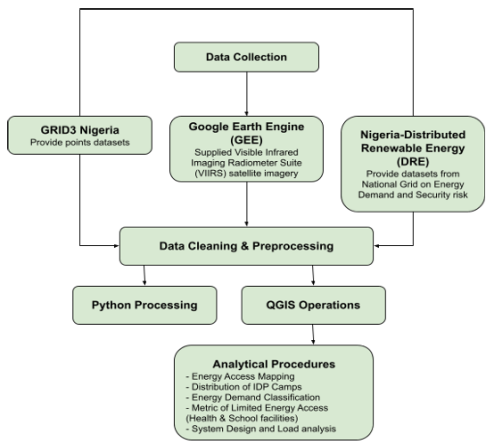



 Share This Article
 Twitter
 Linked In
 Facebook